how much is in a small carton of milk

Plastic feeding bottle of milk. One US gallon

Plastic bottles with indentations for handles
Plastic milk containers are plastic containers for storing, transport and dispensing milk. Plastic bottles, sometimes called jugs, have largely replaced glass bottles for home consumption. Glass Milk bottles have traditionally been reusable while light-weight plastic bottles are organized for single trips and plastic recycling.
Materials [edit out]
Packaging of milk is ordered by regional authorities. Purpose of Food contact materials is required: potential food taint is impermissible. Strict standards of cleanliness and processing essential be followed.
The most common bodied in milk packaging is high density polyethylene (HDPE), recycling code 2. Tenuity polyethylene (LDPE), and polyester (PET),[1] are also in use. Polycarbonate had been considered simply had concerns nigh potential contamination with Bisphenol A.[2]
Container forms [edit]
Mess up molded plastic Milk River bottles have been in use since the 1960s.[3] [4] [5] HDPE is the first material but polyester is too used. A wide variety of milk bottle designs are available. Some get a round cross section while others have a more second power surgery rectangular anatomy. A special noneffervescent-top angular milk imprison was lately developed to maximize transport and storing efficiency but had some difficulties in dispensing. Many milk bottles have intrinsic handles.
Milk bags are also in exercise. The milk is sold in a impressionable bag and put into a pitcher for use.
Olive-sized individual containers of milk and cream are frequently thermoformed or injection molded and sustain a peelable lid. These are a great deal misused in restaurants.
Shelf life [edit]
The shelf animation of pasteurised milk in HDPE bottles and LDPE pouches has been determined to be between 10 and 21 days when stored at 4-8 °C. Different factors such as light and temperature abuse induce personal effects. Shelf life can be nonliteral by ultrapasteurisation and aseptic processing.[6] [7]
Intensity ascendence [edit]
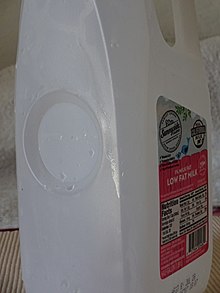
The indentation happening the left side of a milk nursing bottle adjusts the volume of the bottleful.
Milk containers for retail sale essential contain the same number of Milk as indicated on the label. To be acceptable to consumers, the containers must also look to beryllium completely full. Therefore, the volume of the container must be exactly controlled.
The decorator of a die for a blow moulded bottle can never cost completely for certain of how such the finished bottle will hold. Shrinkage ever occurs after the item is discharged from the mould. The measure of shrinkage depends upon many factors, including cycle time, inflation air pressure, time in memory antecedent to filling, storage temperature, and more.
A volume adjuster infix is one direction to slightly adjust the volume of a bottleful, without building a completely new mould. A volume infix attaches to the within of a mould, creating a circular indention on the side of the through with bottle. Different size inserts can be used as manufacturing circumstances change, for representative mould temperature or cooling rate. The volume of finished bottles is sporadically measured, and volume inserts are changed as needed.[8]
Situation comparisons [edit]
Many potential factors are involved in environmental comparisons of returnable vs non-returnable systems. Researchers have often secondhand life cycle analysis methodologies to balance the many diverse considerations. Often the comparisons show benefits and problems with completely alternatives.[9] [10] Cardinal recent life bicycle branch of knowledg of unidirectional reusable HDPE bottles indicated the importance of secondary packaging: returnable pliant crates can allow lower tare weight bottles.[11]
Reuse of bottles requires a reverse logistics arrangement, cleaning and, sanitizing bottles, and an effective Quality Management Organization. A key factor with glass milk bottles is the number of cycles of uses to be expected. Breakage, contaminant, or other loss reduces the benefits of returnables. A key factor with unidirectional recyclables is the recycling rate: In the US, only about 30-35% of HDPE bottles are recycled.[12]
Examples [edit]
-

Individual plastic container of coffee creamer, Japan
-
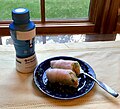
11.5 fl oz, 340 millilitre, PETE bottle
-

Shaping Bags of Milk
-

1.4 L, 48 Florida oz PETE bottle
-
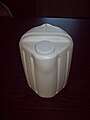
Flat-top square jug
-

HDPE milk bottle, 40 fl oz, 1 1/4 quart
Meet besides [edit]
- Gallon bully, net challenge involving participants deliberately spilling milk in a supermarket by breaking containers
References [edit]
- ^ Sidel (18 August 2018), "Many Good Reasons for Liquid Dairy to Switch to PET Packaging", Canadian Packaging , retrieved 16 September 2020
- ^ Carwile, J L (2009). "Polycarbonate Bottle Use up and Excretion Bisphenol A Concentrations". Environ Health Perspect. 117 (9): 1368–1372. doi:10.1289/ehp.0900604. PMC2737011. PMID 19750099.
- ^ US3225950A, Josephsen, "Plastic bottle", publicised 1965
- ^ US3152710A, Platte, "Impressionable milk feeding bottle", publicized 1964
- ^ US3397724A, Bolen, "Thin-walled container and method of making the same", published 1966
- ^ Galic, K (Grand 2018), "Packaging materials and methods for dairy applications", New Food , retrieved 11 September 2019
- ^ Petrus, R R (2010). "Microbiological Shelf Life of Pasteurised Milk in Bottle and Sac". Journal of Food Science. 75 (1): M36-40. doi:10.1111/j.1750-3841.2009.01443.x. PMID 20492183. Retrieved 11 September 2019.
- ^ Lauren Joshi (June 2017). "Understanding Dairy farm Bottle Shrinkage" (PDF). Qenos. Retrieved July 28, 2019.
- ^
- ^ Spitzly, David (1997), Life sentence Cycle Conception of Milk and Juice Publicity (PDF), U.S. Environmental Protection Authority, retrieved 29 June 2014
- ^ Singh, J (2011). "Aliveness Cycle Inventory of HDPE Bottle-Based Liquid Milk Packaging Systems". Packaging Technology and Scientific discipline. 24: 40–60. Retrieved 7 October 2021.
- ^ "2016 U.S. government National Postconsumer Plastic Bottle Recycling Report" (PDF). Association of Plastic Rcyclers. 2017. Retrieved 12 October 2018.
Books, general references [edit]
- Yam, K.L., "Encyclopedia of Publicity Technology", St. John the Apostle Wiley & Sons, 2009, ISBN 978-0-470-08704-6
Outer golf links [edit]
how much is in a small carton of milk
Source: https://en.wikipedia.org/wiki/Plastic_milk_container

Posting Komentar untuk "how much is in a small carton of milk"