a plasma membrane lipid that stabilizes the plasma membrane
5.4: Plasma Membrane
- Page I.D.
- 16742

This elliptic, cut-aside model of an animal prison cell (Figure \(\PageIndex{1}\)) shows that a cell resembles a plastic bag wide of Set-O. Its first structure is a cytomembrane filled with cytol. Like Congeal-O containing mixed fruit, the cytoplasm of the cell also contains single structures, such as a nucleus and other organelles. Your body is ready-made up of trillions of cells, but all of them perform the same basic life history functions. They all prevail and use energy, respond to the environment, and regurgitate. How dress your cells put through these BASIC functions and keep themselves — and you — alive? To respond these questions, you need to know more about the structures that make up cells, starting with the plasma tissue layer.
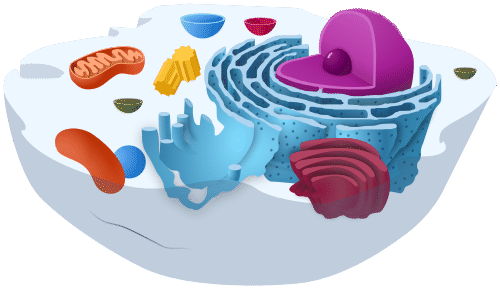
The plasma membrane is a social organization that forms a barrier 'tween the cytoplasm inside the cell and the environment outside the prison cell. Without the cytomembrane, on that point would be no cell. The membrane also protects and supports the cell and controls everything that enters and leaves IT. It allows only foreordained substances to pass through while safekeeping others in or unsuccessful. To understand how the plasm tissue layer controls what passes into or impossible of the cell, you need to know its basic structure.
Phospholipid Bilayer
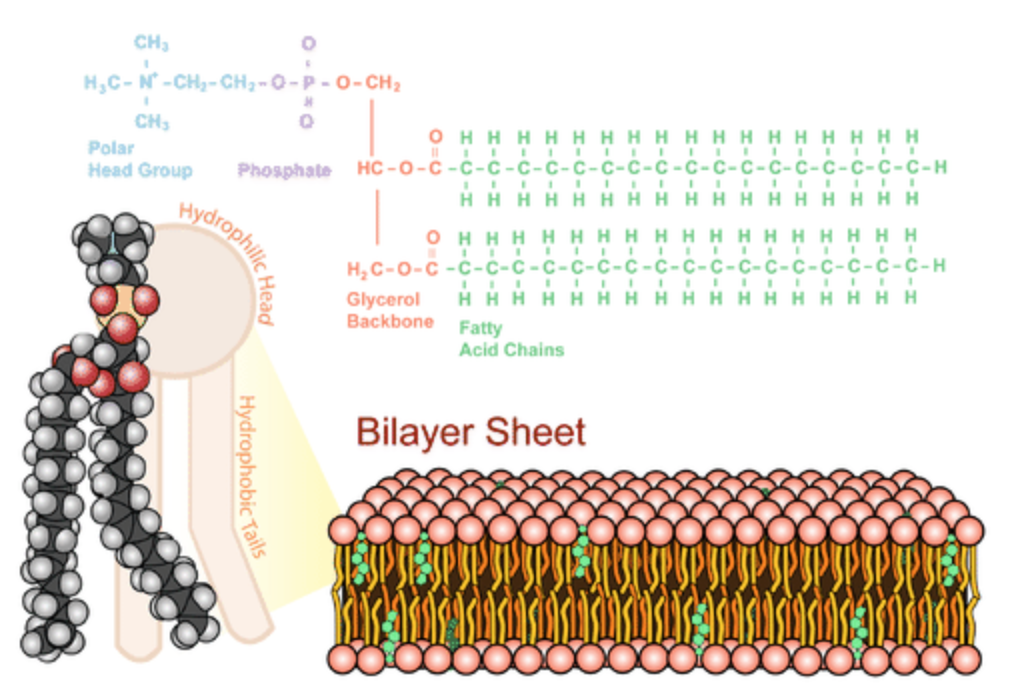
The plasma membrane is composed mainly of phospholipids, which consist of fatty acids and inebriant. The phospholipids in the plasma tissue layer are arranged in two layers, called a phospholipid bilayer, with a aquaphobic, or piss-hating, interior and a hydrophilic, or water-loving, out-of-door. Each phospholipid molecule has a head and two tails. The head "loves" water (hydrophilic) and the tails "fear" piddle (hydrophobic). The water-fearing tails are on the interior of the membrane, whereas the healthy heads point outwards, toward either the cytoplasm or the mobile that surrounds the cell. The polar head radical and fatty acid chains are attached away a 3-carbon glycerol unit. Figure \(\PageIndex{2}\) shows a single phospholipid next to a phospholipid bilayer.
Molecules that are hydrophobic can easily pass through the plasma tissue layer if they are small enough because they are water-hating equivalent the interior of the membrane. Molecules that are hydrophilic, but then, cannot transit the plasm membrane — at least not without help — because they are water-amatory like the exterior of the membrane.
Other Molecules in the Plasma Membrane
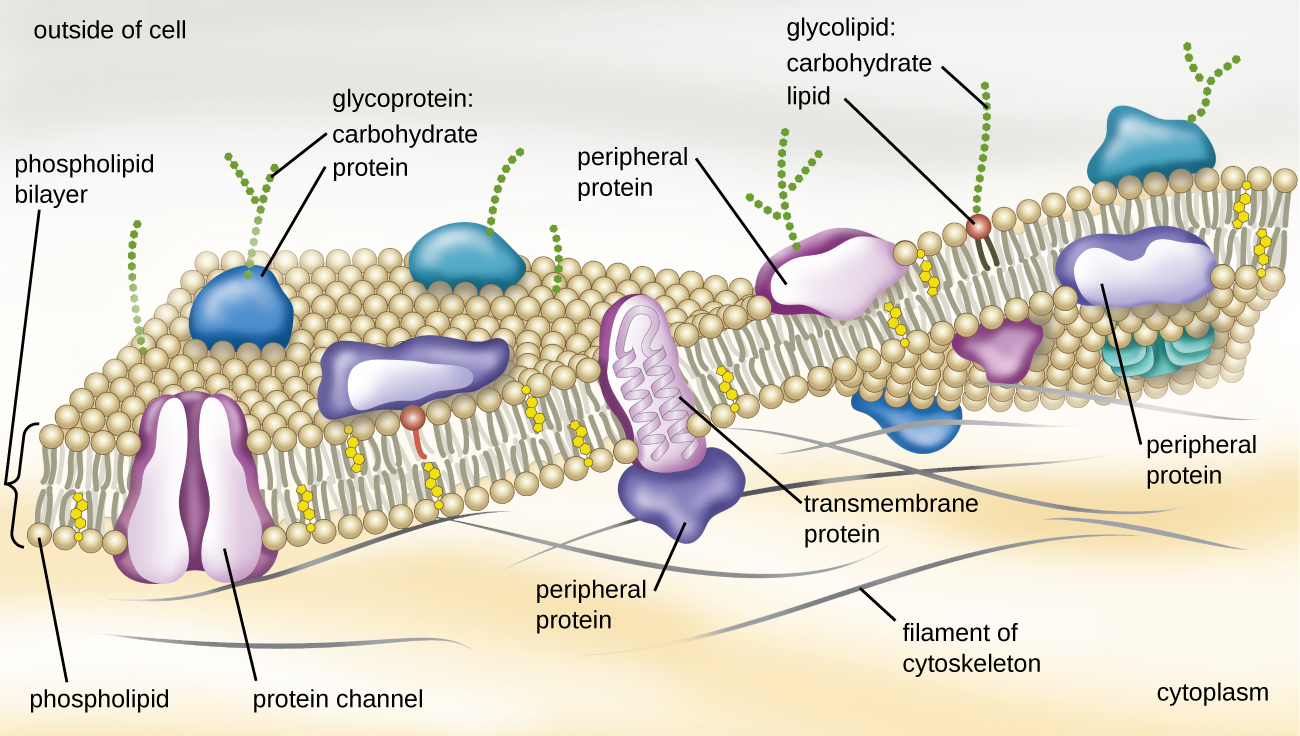
The plasma tissue layer also contains another molecules, primarily new lipids and proteins. The unripe molecules in Figure \(\PageIndex{2}\), for example, are the lipid cholesterol. Molecules of the steroid lipoid cholesterin help the cytomembrane keep its forge. (Cipher \(\PageIndex{3}\)) shows the cholesterol molecules as yellow structures within the center of the phospholipid bilayer. Other structures shown in (Figure \(\PageIndex{3}\)):
- Protein channels. These span the loaded membrane and have a space inside them because they are used to transport materials into Oregon out of the cell.
- Transmembrane proteins. The root "trans" explains that these pair (go "across") the membrane. Transmembrane proteins can have a variety of functions.
- Skirting proteins. These are found only on one side of the membrane. They buttocks be constitute on either the cytoplasmic side surgery the outside of the membrane.
- Glycoproteins. These dwell of a protein in the plasma membrane with chains of carbohydrates projecting out of the cell.
- Glycolipids. These are chains of carbohydrates committed directly to a lipide in the membrane. Both glycoproteins and glycolipids act as labels to identify the cell.
- Filaments of cytoskeleton are institute along the cytoplasmic English of the tissue layer and provide a scaffolding for the membrane.
Additional Functions of the Plasma Membrane
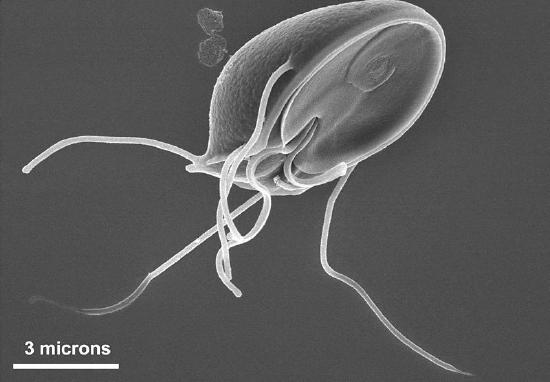
The plasm membrane may have extensions, so much as whip-like flagella operating room encounter-ilk cilia, that give it else functions. In one-celled organisms, like those shown below, these membrane extensions may helper the organisms move. In multicellular organisms, the extensions take up divers functions. For instance, the cilia on human lung cells swing foreign particles and mucus toward the mouth and nose.
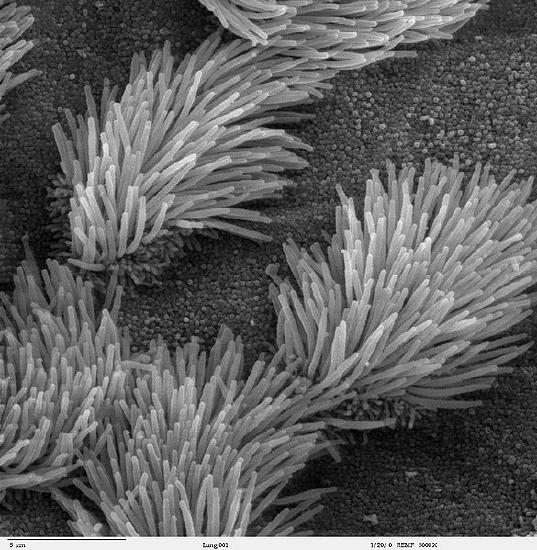
If you smoke and need another reason to quit, here's a good one. We commonly concoct lung cancer as a major disease caused by smoking. But smoking can have crushing effects on the body's ability to protect itself from repeated, serious respiratory infections, such arsenic bronchitis and pneumonia.
Cilia are microscopic, hair-equivalent projects connected cells that line the metabolic process, generative, and digestive systems. Cilia in the systema respiratorium line most of your airways where they induce the job of trapping and removing dust, germs, and other outside particles ahead they can make you sick. Cilia secrete mucus that traps particles, and they move on in a continuous wave-equivalent motility that sweeps the mucus and particles upward toward the throat, where they derriere be expelled from the body. When you are sick and cough out up phlegm, that's what you are doing.
Smoking prevents cilia from performing these important functions. Chemicals in tobacco smoke paralyze the cilia so they can't swing mucus out of the airways and they also inhibit the cilia from producing mucus. Fortunately, these effects start to wear off presently later the high exposure to tobacco bullet. If you stop smoke, your cilia leave return to median. Even if prolonged smoking has destroyed cilia, they bequeath regrow and resume functioning in a matter of months later on you stop smoking.
Followup
- What are the ecumenical functions of the plasma membrane?
- Discover the phospholipid bilayer of the plasm membrane.
- Identify other molecules in the plasma tissue layer, and state their functions.
- Why do some cells have cytomembrane extensions such as flagella and cilia?
- Explain why hydrophilic molecules cannot well pass through the prison cell membrane. What type of molecule in the cubicle membrane might help hydrophilic molecules pass through IT?
- Which part of a phospholipid molecule in the plasma membrane is ready-made of fatty acid chains? Is this part hydrophobic Oregon hydrophilic?
- The ii layers of phospholipids in the cytomembrane are called a phospholipid ____________.
- Confessedly operating room False. The flagella happening your lung cells sweep foreign particles and mucus toward your mouth and olfactory organ.
- True or False. Small afraid molecules can easily pass through the plasma membrane.
- True or Unrealistic. The side of the plasma membrane that faces the cytoplasm is hydrophilic.
- Steroid hormone hormones can slip by straightaway finished electric cell membranes. Why coif you think back this is the caseful?
- Some antibiotics work by devising holes in the plasma tissue layer of bacterial cells. How do you guess this kills the cells?
- What is the name of the prolonged, lash-like extensions of the plasma membrane that helps some single-celled organisms move?
Explore More
- Siskin-like mobile phone model by Kevin Song, devoted CC0 via Wikimedia Common
- Phospholipid bilayer by LadyofHats, CC Past-Old North State 3.0 for CK-12 Founding
- Plasm membrane by CNX OpenStax, licensed CC BY 4.0 via Wikimedia Commons
- Giardia by CDC/ Dr. Stan Erlandsen, public domain via Wikimedia Commons
- Cartilaginous tube cells away Charles Daghlian, released into the public world via Wikimedia Common land
- School tex adapted from Weak Biological science by CK-12 licensed CC Away-NC 3.0
a plasma membrane lipid that stabilizes the plasma membrane
Source: https://bio.libretexts.org/Bookshelves/Human_Biology/Book:_Human_Biology_%28Wakim_and_Grewal%29/05:_Cells/5.04:_Plasma_Membrane

Posting Komentar untuk "a plasma membrane lipid that stabilizes the plasma membrane"